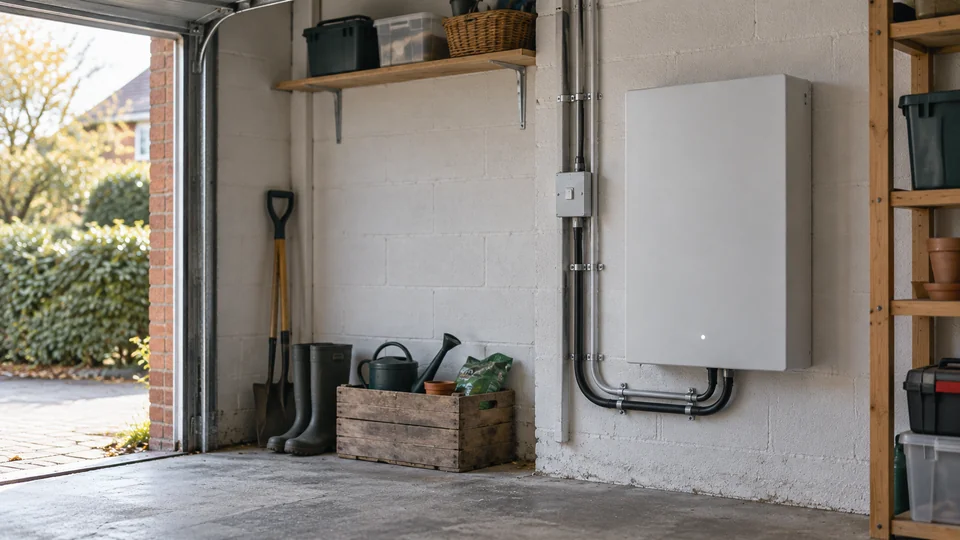
Estimate what a battery might save by charging when electricity is cheaper and supplying some later use. The default Flux example gives about £157 a year and a 29.3-year simple payback, which is longer than a typical battery lifespan.
Last checked: 27 October 2026. Results depend on your tariff, electricity use, battery and installed price.
Estimated result: Octopus Flux
Measure
Estimate
Annual bill saving from battery shifting
£157
Simple payback on installed cost
29.3 years
Compared with a typical 10–12-year lifespan
Beyond the upper end (12 years)
Average tariff unit price without a battery, even use
25.53p
At these figures, the battery saves about £157 a year. Simple payback is 29.3 years. The tariff’s average unit price with even use is 25.53p, compared with the Ofgem cap average of 26.32p/kWh.
The payback estimate divides installed cost by annual bill saving. It does not allow for financing or replacement. For Custom, values are not sourced; enter your own rates and hours.
What the default result means
With the default Flux prices, grid-only shifting saves about £157 a year in this model. The estimated payback is 29.3 years, beyond Energy Saving Trust’s typical battery lifespan of 10–12 years. Under the Go defaults, the model gives about £330 a year and a 14.0-year payback. These calculations do not include solar charging or export arbitrage.
Can a home battery pay for itself by charging from the grid?
At the default Octopus Flux prices, the model estimates about £157 a year and a simple payback of 29.3 years. That is longer than Energy Saving Trust’s typical 10–12-year battery lifespan. This model suggests grid-only arbitrage is unlikely to repay a typical battery within its stated lifespan at these prices. Your tariff, use, battery and quote can change the result.
Flux is listed for homes with solar and a battery, Go for EV owners, and Cosy for heat pump owners. Eligibility and rates can change; check the supplier’s terms. We are not paid to name any tariff; other suppliers’ tariffs differ. All Octopus rates shown include VAT.
Can I use this calculator for solar battery storage?
This calculator does not model solar generation or solar charging; it estimates shifting electricity bought from the grid between tariff periods. For a solar-and-battery estimate, use our solar payback calculator and select “Add a battery”; you can change the share of solar generation used at home and the extra battery cost. Our guide to adding a battery to solar panels covers checks before adding storage. GOV.UK explains that a battery can store surplus solar electricity for use later. The calculator gives an estimate based on its assumptions, not a quote or guaranteed saving.
A battery can store surplus solar electricity for later use. The UK Parliament POSTnote estimates self-consumption of about 30–40% without a battery and 70–80% with one. It cites Great British Energy examples where annual bill savings rose from about £150 to £450 with a battery; that is an example, not a promise. Try our solar payback calculator with its battery option for a solar-generation estimate.
It is the share of electricity put into a battery that can be used again. This calculator assumes 90%, the lower end of the 90–95% range in a University of Cambridge paper. A real battery may perform differently.
How long does a home battery last, and what does it cost?
Energy Saving Trust gives a typical lifespan of about 10–12 years and a guide price of about £4,600 for a 5 kWh battery. At the default Flux result, estimated payback is about 29.3 years, beyond that typical lifespan. Get an itemised quote and check the warranty for the battery you are considering.
It assumes one full charge per day in the cheap window and electricity use spread evenly through the day. It does not model solar charging, export arbitrage, battery degradation, standing charges or more than one cycle a day. Cosy has three cheap windows; their separate timings are not modelled.
Optional. A smart plug does not replace a battery or a proper survey by an installer.
Cookies
We'd like to use Google Analytics cookies to see how people use this site so we can improve it. They're optional and only set if you accept. Privacy notice