Guides › Do I need permission for a cross-pavement EV charger channel? (England, 2026)
Do I need permission for a cross-pavement EV charger channel? (England, 2026)
Last checked: 17 October 2026 Last reviewed: 13 November 2026 10 questions answered
Yes — and usually more than one. Trailing a charging cable across a public pavement without the highway authority’s consent is unlawful under section 178 of the Highways Act 1980. The lawful route is a pavement-embedded cable channel (a “cross-pavement solution”) installed by, on behalf of, or with the authorisation of your highway authority. From 21 October 2026 that authorised channel is itself permitted development in England (new Class F), and home chargers that rely on it can use widened Class D/E rights — but planning is only one consent. You still need highways (and often street-works) permission, and your council can still say no. Check your authority’s published position in our cross-pavement council checker. Temporary mats or cable covers on top of a loose cable are not what central government guidance treats as the approved permanent solution, and they do not qualify for the on-street parking chargepoint grant.
Last checked: 17 October 2026. Schemes change, so confirm on GOV.UK before you commit.
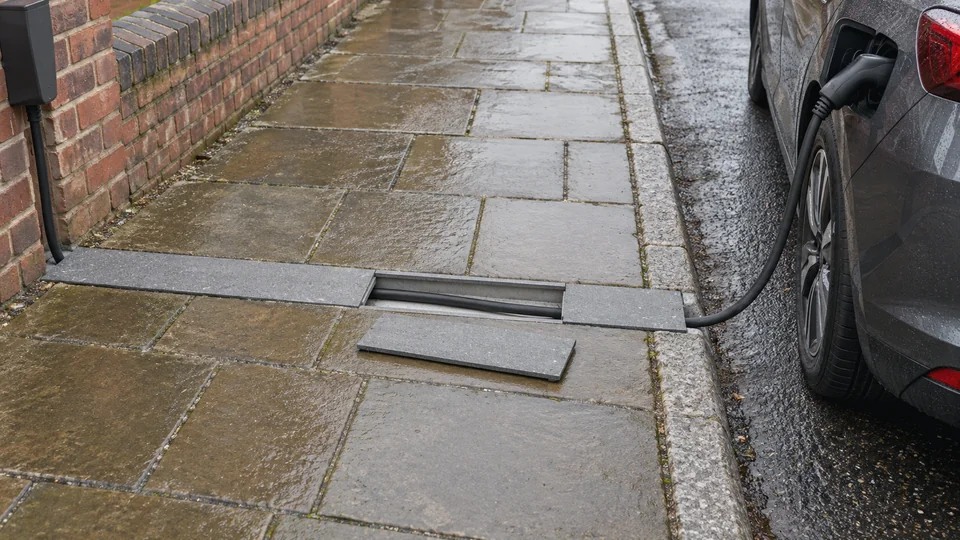
An authorised permanent channel is the lawful route described here; a loose cable across a public pavement requires highway authority consent.
Compare ways to get an EV charging cable across the pavement.
Option
What it involves
Permission and planning point
Loose cable or temporary mat/cover
A cable trails across the public pavement, with or without a cover or mat.
Section 178 requires highway authority consent to place a cable across a highway; temporary mats or covers are not the permanent embedded solution described by GOV.UK and do not qualify for the on-street grant. Highways Act section 178; on-street grant guidance
Pavement channel or gully
A cable is placed in an embedded channel while charging and removed afterwards.
The channel must be installed by, on behalf of, or with the highway authority’s authorisation. From 21 October 2026, authorised installation is permitted development in England subject to listed exceptions; highway consent and any street-works permission still matter. GOV.UK cross-pavement guidance; SI 2026/1056
Buried cable with removable bollard or lance
A permanent cable runs under the pavement and ends at a removable connector.
Can I just run a charging cable across the pavement?
Not lawfully without consent. Section 178 of the Highways Act 1980 says no person shall fix or place any cable, wire or similar apparatus over, along or across a highway without the consent of the highway authority, which may attach reasonable terms and conditions. GOV.UK’s cross-pavement guidance explains that trailing cables create trip hazards and may breach Part IX of the Highways Act. If a trailing lead endangers someone, it can also be an offence under section 161(1) (depositing anything on a highway without lawful authority or excuse, where a user is injured or endangered) or section 162 (placing a rope, wire or other apparatus across a highway in a way likely to cause danger, unless you prove you gave adequate warning), each with a fine of up to level 3 on the standard scale. Your council may ask you to remove a trailing cable, so check with your council (the highway authority). Temporary covers or mats laid on top of a cable are not the permanent embedded solutions that guidance focuses on, and GOV.UK’s on-street parking grant page says temporary solutions such as cable covers or mats do not qualify for that grant. The alternative is a permanent channel or gully with the council’s consent, or an on-street option.
SI 2026/1056 defines a cross-pavement solution as a pavement-embedded cable channel that lets a recharging cable cross a footway safely from a home to a parked vehicle. GOV.UK guidance describes two main types that authorities have trialled: cable channels or “gullies” set into the pavement (the cable is placed in the channel while charging and removed afterwards), and permanent cables laid under the pavement ending in a removable bollard, lance or similar connector. “Authorised” means installed by, on behalf of, or with the authorisation of the relevant highway authority.
From 21 October 2026, authorised cross-pavement channels are permitted development in England except at scheduled monuments, within the curtilage of listed buildings and in conservation areas. The Town and Country Planning (General Permitted Development) (England) (Amendment) (No. 2) Order 2026 (SI 2026/1056) came into force on that date. It adds Class F in Part 9 of Schedule 2 so that installing, altering or replacing a cross-pavement solution by, on behalf of, or with the authorisation of a highway authority is permitted development — except at a scheduled monument, within the curtilage of a listed building, or in a conservation area. It also extends Classes D and E (wall outlets and upstands) beyond off-street parking into other areas of a house or flat-block curtilage, and adds a condition that where a footway sits between the charger and the car, the cable must cross via an authorised cross-pavement solution. Planning permission is still only one of the consents.
Do I still need highways permission after 21 October?
Yes. Permitted development does not replace highways consent. Section 178 still requires the highway authority’s agreement to place a cable across the highway, and the government response on EV charging permitted development rights is explicit that section 178 (and street-works permission) remain necessary. The new Class F right only covers a channel that is already authorised by the highway authority — so if the council refuses authorisation, there is no Class F planning fallback for an unauthorised channel.
You may need a section 50 licence if you or your contractor place apparatus in the street, unless the council or its contractor installs the channel under its own powers and permit. Under section 50 of the New Roads and Street Works Act 1991, anyone who is not a statutory undertaker (and is not an electric vehicle chargepoint operator with the relevant street-works code) who wants to place or retain apparatus in the street — GOV.UK’s March 2026 guidance expressly includes cross-pavement EV charging solutions — must apply to the highway authority for a section 50 street works licence. Where the council or its contractor installs the channel under their own powers, work may proceed under their permit instead. Fees, forms and processing times vary by authority; ask your county or city highways team which route they use.
Is there a grant for the charger if I only have on-street parking?
Yes, where you qualify. The Electric Vehicle Chargepoint Grant for Households with On-Street Parking pays 75% of the cost to buy and install a socket, up to £500, if you own or rent and live at the property, only have on-street parking, and install a permanent cross-pavement solution. Temporary covers or mats do not qualify. Funding is confirmed until 31 March 2027. The grant is for the chargepoint; whether the channel itself is free, subsidised or chargeable depends on your council’s scheme (for example Nottinghamshire’s LEVI-funded pilot covers channel installation up to 2m for eligible households, while the householder still pays for the chargepoint).
Who is the highway authority in the East Midlands?
In two-tier areas the county council is usually the highway authority; planning sits with the district or borough. Ask Derbyshire, Nottinghamshire, Leicestershire or Staffordshire County Council about channels on county roads. In Derby, Nottingham, Leicester and Stoke-on-Trent the unitary city council is the highway authority. Unadopted or private roads need the landowner’s permission instead of (or as well as) the highway authority. Policies differ and change: Nottinghamshire County Council runs an Electric Vehicle Cable Channel pilot for eligible homes with no off-street parking; Leicestershire and Staffordshire County Councils currently state that residents are not permitted to trail cables or install private cross-pavement channels — check their pages before you book.
No. GOV.UK guidance and Nottinghamshire’s pilot both say a cross-pavement solution does not give you ownership or priority over the parking space outside your home (unless the space is already a designated disabled bay or similar). You must still obey local parking restrictions and controlled parking zones. The channel only makes it safer to get a cable to a car when you can park legally near it.
Do cross-pavement charger rules apply to listed buildings, conservation areas and flats?
Class F (the channel) and the new “other area” charger rights do not apply in conservation areas; neither the charger PD rights nor Class F apply at listed buildings or scheduled monuments. Listed Building Consent is a separate question for your local planning authority. Flats above ground floor are often unsuitable for a channel that needs a ground-floor domestic supply — Nottinghamshire’s pilot excludes them. Renters and leaseholders still need written landlord or freeholder permission for the chargepoint and any works on the property.
(1) Confirm you have no usable off-street parking and that you can park legally near the property. (2) Ask your highway authority whether it runs or authorises cross-pavement channels and what licence (section 178 consent, section 50, or a council-led install) applies. (3) Check planning: from 21 October 2026 many authorised setups need no planning application, but listed buildings, conservation areas and Article 4 directions still matter — see our planning guide. (4) Use an OZEV-authorised EV chargepoint installer for the chargepoint if you want the on-street grant, and keep DNO notification and Building Regulations Part P in mind. (5) Do not trail a cable or book groundwork until highways permission is clear.
Which accessories could support a cross-pavement charger setup?
Optional cable and storage accessories can support the setup, but they do not replace an authorised pavement channel.
Ad: links to Amazon. As an Amazon Associate we earn from qualifying purchases, at no extra cost to you.
Never trail a cable across a public pavement without the highway authority’s consent. A loose cover or mat does not make it lawful or qualify for the grant. Use a cable across the pavement only through a channel installed or authorised by the highway authority.
Type 2 charging cable (5 m)
Masterplug Mode 3 EV Fast Charging Cable with Carry Case, Type 2 to Type 2, 5 m, 22 kW, 32A
Useful when your chargepoint has a socket rather than a built-in cable.
For untethered Type 2 AC chargepoints. Confirm that its length and your charging setup suit the channel authorised by your highway authority.
Occasional updates. We'll email you a link to confirm. Unsubscribe any time. See our privacy notice.
Cookies
We'd like to use Google Analytics cookies to see how people use this site so we can improve it. They're optional and only set if you accept. Privacy notice